Commercial EV
chargers, Level 2. Two paths,one platform.
Two families. Two business models.
One OCPP backbone.
Scroll to explore
Pick a commercial Level 2 EV charger for your business model:
charge as a benefit for employees, residents, and fleets, or
charge as a service for retail customers and parking guests. Same hardware, same OCPP backbone, same eMÖTEN platform.
Commercial
Level 2 EV chargers. Two paths,one platform.
Two families. Two business models.
One OCPP backbone.
Starting Price · LYNX
02 · The Decision
First, one question: do you charge for it?
Every commercial Level 2 buying decision starts here. Charging as a benefit
and charging as a service look similar from the parking lot, but the firmware,
payment hardware and ROI math are completely different. Pick the right path
and the rest of the decision tree gets simple.
Path A · Non-Monetized
Charging as a benefit.
Power is a perk you provide. Authenticate users; don't bill them.
Pick this if you operate…
A workplace, head office, or campus offering employee charging
An apartment building or residential tower serving residents
A fleet depot: delivery, ride-hailing, transit, municipal
A government / institutional site (hospital, university)
Two commercial charger families. Free to use, or paid.
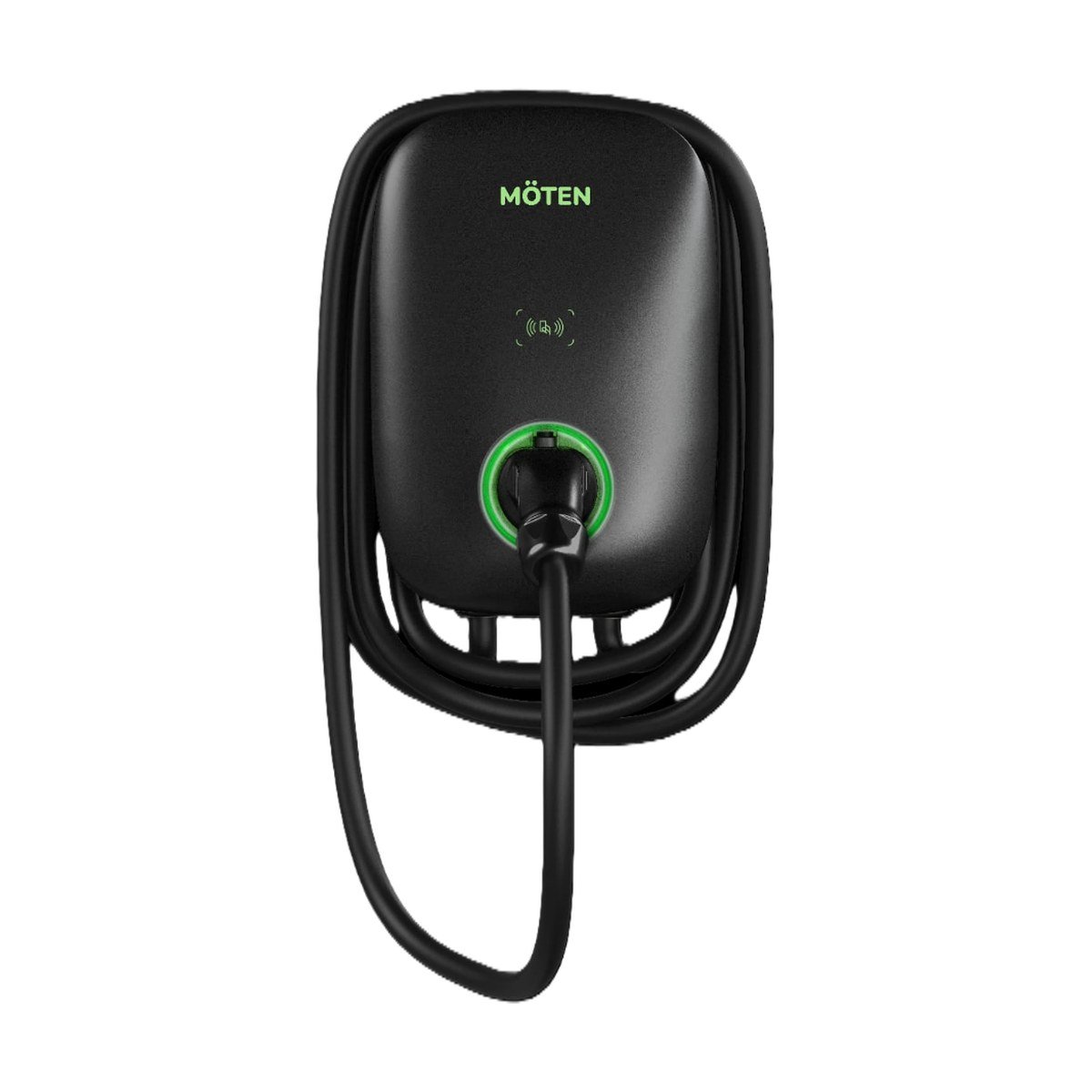
LYNX for charging as a benefit, PHOENIX for charging as a service. Both come in 11 kW and 22 kW with a Type 2 connector and a 7-metre cable, and run the same OCPP and eMÖTEN firmware, with eMÖTEN Power load management on every port.
Pricing notes: Prices in PKR. Add-ons: pedestal kit PKR 70,000; card payment terminal for PHOENIX PKR 280,000; RFID pack of 100 cards PKR 70,000 (10 cards included). eMÖTEN plans are billed per port. 2-year warranty, extendable to 5 years. Volume pricing on 10+ ports: request a volume quote.
Hardware: 400 V AC three-phase, 50 Hz. Type 2 (IEC 62196-2) connector, 7 m cable. RCD Type B (6 mA DC), over and under voltage, over current, surge and over temperature protection. IP65 and IK08, −30 °C to +50 °C. 351 × 250 × 111.5 mm. Wi-Fi, 4G, Ethernet, RFID; OCPP 1.6, 2.0.1 ready.
06 · Use-Case Fit
Match your vertical to the right family.
Four verticals cover most commercial Level 2 sites in Pakistan. Each has a recommended model and a Markets page with deeper guidance: site design, electrical pre-work, approvals and ROI.
DC fast charging gets the headlines, but for most commercial sites, offices, fleets, apartment towers, retail with dwell time, Level 2 is the right answer. 10× lower cost per port, usually no transformer upgrade, and dwell time covers the kWh gap. Here's the math, and our guide to choosing Level 2 vs DC fast by dwell time.
Commercial Level 2
L2: this page
Best for sites where vehicles dwell more than 30 minutes.
Rs
From per port
11–22 kW
Power range
400 V 3-phase
No transformer
~3–6 hr
Full charge
Existing electrical: many buildings have spare three-phase capacity
Approvals in days, not months; a DISCO upgrade is often not needed
10× more ports for the same CapEx as a single DCFC stall
Lower demand charges: gentler on utility billing
DC & Ultra-Fast Charging
DCFC
Best for highway corridors and short-dwell retail (under 30 min).
Rs
From per port
30–720 kW
Power range
400 V 3-phase or 11 kV
Often new transformer
~20–60 min
10–80% charge
Approvals and DISCO coordination, often several months
Civil works (concrete pad, cable trenching), a significant extra cost
Higher revenue per session than Level 2
Highway corridors and short-dwell sites where speed matters most
Figures are typical ranges.
Cost per port, civil works, approval timelines and revenue per session vary by site and DISCO. Contact our team for a site-specific
feasibility note.
Choose L2 when
Dwell time covers the kWh.
Vehicles park 2+ hours (office, apartment tower, hotel, mall)
Fleet recharges overnight at the depot
You need 8+ ports on one supply
You want to ship and energize within weeks, not quarters
Budget is constrained: port density matters more than speed
LYNX is for sites where charging is a benefit: offices, apartment buildings and fleet depots. Users start a session with an RFID card or the eMÖTEN app and don't pay at the charger. PHOENIX is for sites that sell charging: retail, parking, hotels and restaurants. Drivers pay by scanning a QR code (card or Raast), and a card payment terminal can be added. Both come in 11 kW and 22 kW.
How much does a commercial Level 2 EV charger cost in Pakistan?
LYNX starts at PKR 224,000 and PHOENIX at PKR 252,000 (11 kW). The installed cost also depends on cable runs, protection, mounting and any supply upgrade, so we quote after a site survey. Request a quote; we usually reply within one business day.
How many chargers can my building's supply support?
Often more than a simple calculation suggests. eMÖTEN Power, the load management layer in eMÖTEN CMS, shares the available supply between the chargers that are actually charging, so many buildings can add chargers without a bigger DISCO connection. MÖTEN Install confirms the load calculation for your site.
Which connector and cars do they work with?
Both families use the Type 2 (IEC 62196-2) connector with a 7-metre cable, which fits most EVs sold in Pakistan. Check a vehicle's charging inlet if you are unsure.
How do drivers pay on PHOENIX?
Drivers scan the QR code and pay by card or Raast, with no app needed. With the optional payment terminal they can also tap or insert a bank card. eMÖTEN can also sell cash voucher credit at your front desk. Payments need a CARINA plan; see eMÖTEN plans.
Is eMÖTEN software included?
In Pakistan, eMÖTEN is billed per port: AURIGA-L2 for free-to-use sites (LYNX) and CARINA for paid charging (PHOENIX), each PKR 33,600 a year per port, plus a one-time setup fee. The chargers also work on any other OCPP 1.6 system; you are never locked in.
How fast is delivery?
LYNX and PHOENIX ship from stock in Karachi. MÖTEN Install schedules installation after the site survey.
What warranty and uptime do I get?
A 2-year manufacturer warranty on every charger, extendable to 5 years, and a 97% uptime SLA on the eMÖTEN platform.
Ready to spec it out?
Tell us about your site.
Our commercial team will scope ports, models, electrical pre-work and approvals, usually within one business day. No quote walls, no gatekeeping.